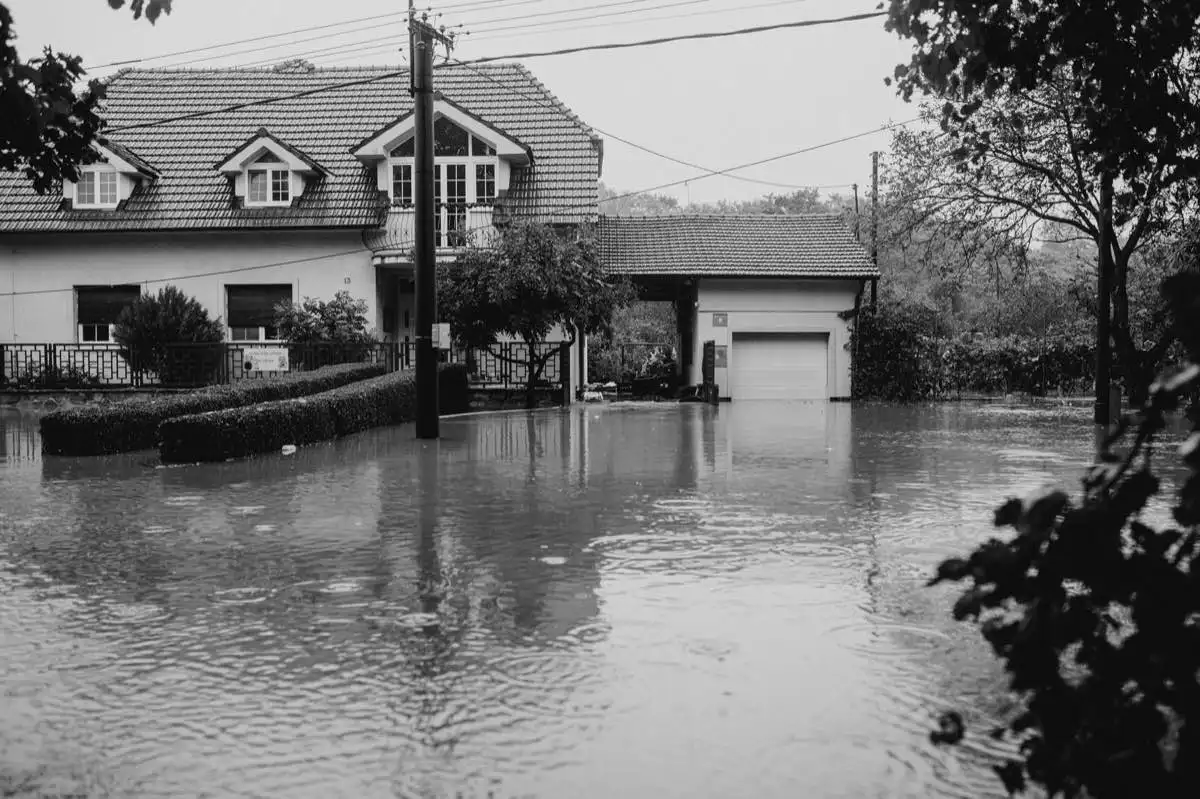
Short answer: surface water dries in about 24 to 48 hours with professional equipment. Water inside walls, subfloor, and framing takes 3 to 5 days or more. And the number that actually matters isn't the drying time at all — it's the 24-to-48-hour window before mold starts growing. That's the clock you're really racing.
Here's the part nobody tells you at 11 PM when you're standing in a wet hallway Googling this: the water you can see is the easy part. It's the water you can't see — soaked into drywall, wicking up the studs, pooling under the subfloor — that decides whether this is a three-day job or a three-week one. Let's break down the real timeline.
The water damage drying timeline
Different materials give up water at wildly different speeds. Here's roughly how long each one takes to dry with commercial air movers and dehumidifiers running around the clock — not with the box fan from your garage.
| What's wet | Typical drying time | Notes |
|---|---|---|
| Surface water (tile, sealed floors, countertops) | 24–48 hours | Dries fast once extracted; rarely the real problem |
| Drywall & baseboards | 3–5 days | Wicks moisture upward; often wet inside the cavity |
| Subfloor & studs | 5–7+ days | Slow to release water; where hidden mold hides |
| Structural framing (heavy saturation / flood) | 1–2 weeks | Dense wood, category 3 water, extensive damage |
Those are honest industry ranges, not a promise. A pinhole leak in a Sparks kitchen dries far faster than two inches of flood water across a whole floor. But the pattern holds: the deeper the water went, the longer it takes, and the more of the work happens where you can't see it.
Why "it feels dry" is a trap
You touch the wall. It feels dry. Job's done, right?
No. Drywall is basically a sponge with a paper coat. The surface dries first while the core and the wood behind it stay soaked. We've walked into rooms that looked bone-dry to the homeowner and pulled 40% moisture readings out of the wall — plenty wet enough to grow mold.
The only way to know something is actually dry is a moisture meter reading, compared against a dry section of the same material. That's the gap most DIY dry-outs fall into: they stop when it looks done, weeks before it is done.
What changes the drying time
Four things move the number up or down more than anything else:
- Category of water. Clean water from a supply line (Category 1) is the fast case. Gray water from an appliance (Category 2) and black water from sewage or flooding (Category 3) are slower and dirtier — more has to be removed, not just dried.
- What got wet. Tile and concrete shrug it off. Drywall, carpet pad, insulation, and hardwood hold water for days.
- Humidity. Dry air pulls moisture out; muggy air fights you the whole way. This is where climate matters.
- Sparks climate specifically. In the Truckee Meadows, the outdoor humidity is often the enemy. Opening the windows to "air it out" can actually pump more moisture in. That's why the pros seal the room and run dehumidifiers instead of relying on fresh air.
The opinion nobody selling dehumidifiers wants to hear
Here's a take we'll stand behind: a box-store dehumidifier and a couple of house fans will not dry the inside of your walls, and the hidden moisture is exactly what grows mold.
Those units are built to shave humidity off the air in a damp basement. They are not built to pull water out of saturated framing and subfloor against Sparks's humidity. A pro air mover moves several times the airflow, aimed at the wet material, paired with a commercial dehumidifier that actually keeps up. If the water only touched a small area of tile, sure — dry it yourself and save the money. But once it's in the drywall, the DIY route usually just buys you a mold problem three weeks later.
The ceiling stain that keeps spreading
You know the one. A small brown ring shows up on the ceiling after a roof leak or an upstairs mishap. You wipe it, tell yourself it's fine, and over the next few days it quietly grows a half-inch wider every morning.
That stain is water still moving through the drywall and insulation above it — and it's a countdown, not a cosmetic problem. By the time the ring stops spreading on its own, the cavity above has often been wet long enough for mold to take hold. Catch it in the first day or two and it's a drying and water extraction job. Wait a week and it becomes a mold remediation job. Same leak, very different bill.
When to call a pro
Handle it yourself if it's small, clean, and shallow — a cup of water on sealed tile, a minor supply-line drip you caught immediately. Wipe, dry, move on.
Call a restoration crew if any of these are true:
- The water reached drywall, baseboards, carpet, or flooring
- It's been sitting more than 24 hours
- The water is gray or black (appliance, storm, or sewage)
- You can smell must or see any spotting
- It came from above and there's a spreading stain
The reason isn't upselling — it's that professional structural drying with metered readings is the only way to beat the mold clock and prove the wall is dry before it gets closed back up.
Drying isn't the same as "fixed"
One thing that trips people up on timelines: drying and repairs are two separate clocks. Getting the structure dry to a meter reading might take 3 to 5 days. Replacing the drywall, repainting, or laying new flooring happens after that, and it's not part of the drying window.
So when someone asks "how long until my house is back to normal," the honest answer is drying time plus repair time. A minor leak might be dry in three days and patched in one. A flood can be a couple of weeks of drying before repairs even start. Anyone who quotes you a single tidy number for the whole thing before they've seen a moisture reading is guessing.
The bottom line
Surface water: 24 to 48 hours. Walls and framing: 3 to 5 days or more. Mold's head start: 24 to 48 hours. That last number is why the goal isn't just to dry fast — it's to start fast, dry to the core, and verify it with a meter, not a hand.
If water reached your walls or floors in Sparks or anywhere across the Truckee Meadows, Sparks Water Restoration Pros runs 24/7 with truck-mounted extraction, commercial drying, and daily moisture checks — and we bill insurance directly. Free inspection, straight answers: call (844) 936-3179.
Ready for a free quote in Sparks?
Sparks Water Restoration Pros — free estimate, clear scope, no pressure. Use the form on this page or jump to the homepage quote.
Related services in Sparks
Sparks Water Restoration Pros money pages — go straight to the service you need.
- Emergency Water Extraction →
Most of the water we pump in Sparks was never inside the heated part of the house. It came off a garage wall, a crawl space line, or a hose bib on the north side of a rental nobody had walked through since October.
- Structural Drying & Dehumidification →
Sparks sits at roughly 4,400 feet in air that runs 15 to 25 percent relative humidity most of the year. That is a free dehumidifier, and it changes how we dry, right up until the temperature drops and it stops working.
- Mold Remediation →
Mold is a genuine problem here, but not a general one. Ambient air in Sparks is too dry to support growth on its own, so every colony we find is fed by a specific, ongoing source of water, and that source is almost always outside the heated envelope.
- Flood Damage Restoration →
Flooding here is a January and February problem, not a summer one. Warm rain lands on a snowpack over ground frozen hard enough to shed water, and Steamboat Creek, the Truckee River and every roadside ditch in the valley take it all at once.
- Storm, Snowmelt & Ice Damage →
Nevada does not get hurricanes, and a page pretending otherwise would be useless to you. What the Truckee Meadows gets is a Sierra storm track: heavy wet snow, downslope wind out of the west, and thaw cycles that move water sideways through a building.
Frequently asked questions
Does water damage dry on its own?
Surface puddles will, but the water soaked into drywall, insulation, and subfloor won't fully leave on its own before mold starts — usually within 24 to 48 hours in Sparks's humidity. Fans and open windows only move surface moisture. Trapped water needs commercial air movers and dehumidifiers. Call (844) 936-3179 if the water reached walls or flooring.
How long does it take for walls to dry after water damage?
Drywall and baseboards typically take 3 to 5 days to dry fully with professional air movers and dehumidifiers running around the clock. Without equipment it can take weeks, and by then mold has usually started inside the wall cavity where you can't see it.
How fast does mold start after water damage?
Mold can begin growing within 24 to 48 hours of the water sitting, and in a humid Sparks, NV climate it leans toward the fast end. That window is why speed matters more than anything else with water damage.
How can I tell if the water damage is actually dry?
Not by touch — a wall can feel dry on the surface while the cavity behind it is still soaked. The only reliable way is a moisture meter reading compared against a dry area of the same material. That's what our crews check daily before calling a job done.
How long does the whole water damage restoration take?
Drying is usually 3 to 5 days; the full job — extraction, drying, then any repairs — runs anywhere from a few days for a minor leak to a couple of weeks for a flood. Sparks Water Restoration Pros gives you a moisture timeline up front so you're not guessing. Call (844) 936-3179 for a free inspection.
Local context
How this applies in Sparks, NV
Every article here is written from water damage work done in Sparks and the Truckee Meadows, so the numbers reflect local labour, permit and material costs rather than a national average. Your own job can land either side of them depending on access, the condition of what is already there, and the materials you pick — IICRC S500 water categories 1, 2 and 3, low-grain refrigerant dehumidifiers, desiccant dehumidification below 40 degrees.
The way to turn any of this into a real answer is to have someone look at your actual situation. The free estimate is free, itemized and written down, with no deposit and no obligation. Call (844) 936-3179 or start on the Sparks Water Restoration Pros homepage.
Areas Sparks Water Restoration Pros covers
Sparks first, then the surrounding communities of the Truckee Meadows. Each has its own page with local detail rather than a copy of this one:
- Reno, NV — Washoe County, incorporated in 1903, population 264,165 at the 2020 census
- Sun Valley, NV — Washoe County, an unincorporated community north of Sparks, population 21,178 at the 2020 census
- Spanish Springs, NV — Washoe County, an unincorporated valley northeast of Sparks, population 17,314 at the 2020 census
- Cold Springs, NV — Washoe County, in the North Valleys, population 10,153 at the 2020 census
- Lemmon Valley, NV — Washoe County, in the North Valleys, population 4,987 at the 2020 census
- Golden Valley, NV — Washoe County, an unincorporated community north of Reno, population 1,580 at the 2020 census
Or jump to the full list of Sparks services.
More from the Sparks Water Restoration Pros blog
- Burst Pipe Water Damage in Sparks: First Steps
Shut off the main, deal with power safely, photograph everything, then extract. The first-hour order of operations for burst pipes in Sparks, NV.
- Water Damage Insurance Claim Steps in Sparks
Document before cleanup, mitigate, then notify your carrier. How a water damage insurance claim actually works for homeowners in Sparks, NV.
- What Is Secondary Water Damage in Sparks Homes?
Secondary water damage is what high humidity ruins after the water is gone: cupped floors, swollen MDF, musty cavities. How to stop it in Sparks, NV.
The Sparks Water Restoration Pros Team
water damage specialists serving Sparks, NV
Written by the Sparks Water Restoration Pros team — insured water damage pros with 12+ years serving Sparks, NV and the surrounding area.